
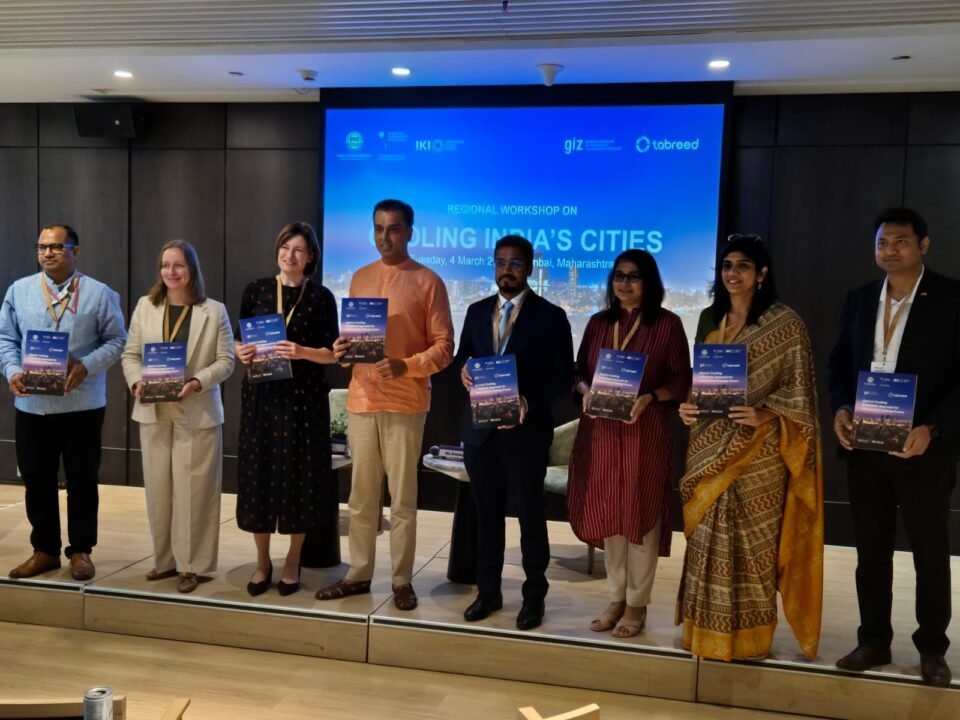
Mumbai, 4 March 2025 – Maharashtra is rapidly advancingtoward a USD 1 trillion economy. Balancing rapid urbanisationwhile ensuring sustainability has become a pressing challenge.Recognising this, Tabreed India, in collaboration with the Bureau of Energy Efficiency (BEE) and Deutsche Gesellschaft für Internationale Zusammenarbeit (GIZ) GmbH, successfully hosted its third regional workshop, ‘Cooling India’s Cities,’ in Mumbai, Maharashtra. The event is part of an ongoing Memorandum of Understanding (MoU) between Tabreed India and GIZ’s ‘Energy Efficiency Cooling’ programme, jointly implemented with BEE. The programme is funded by the German Federal Ministry for Economic Affairs and Climate Action (BMWK) as part of the International Climate Initiative (IKI). The workshop brought together key stakeholders to explore how Maharashtra can accelerate its climate and infrastructure strategies through an integrated approach.
Home to India’s largest commercial and industrial hubs, Maharashtra faces a rapidly rising cooling demand, driven by expanding cities, a booming data centre industry and intensifying heat stress. Cities like Mumbai, Nashik, Chhatrapati Sambhajinagar and Solapur, have set ambitious Net Zero targets for 2050, far ahead of India’s national commitment for 2070. Meeting these goals requires an urgent shift in the way urbaninfrastructure is designed, planned, and implemented.
Speaking at the event, Shri Milind Deora, Member of Parliament, Rajya Sabha, remarked:
“With Maharashtra leading an infrastructure transition, robust discussions on technological innovation are essential. Scalable, integrated solutions like District Cooling will be crucial in building economically competitive & climate-resilient cities. A clear climate mandate, along with empowered Mayors to implement it, is the way forward.”
Ms. Ilka Hirt, Deputy Director General for International Policy at the German Federal Ministry of Environment, emphasised the global significance of sustainable cooling:
“The transition to sustainable cooling is not just a national priority, but a global imperative. Through the International Climate Initiative we are committed to supporting India in adopting energy-efficient cooling solutions that align with global climate goals. District Cooling is a critical enabler of urban resilience, helping cities like Mumbai build a future that is both economically and environmentally sustainable.”
Through expert panels and case studies, the workshop explored how District Cooling can support Maharashtra’s existing climate frameworks, including the Maharashtra State Adaptation Action Plan on Climate Change (MSAAPCC) and Mumbai’s Climate Action Plan (MCAP). Industry leaders discussed the opportunity provided by District Cooling Systems (DCS) to integrate with waste-to-energy plants, city gas networks and renewable energy,to create a circular, low-carbon ecosystem. Presenting a real-world example, Mr. Anson Sando, Head of Energy Programs at IIT Madras Research Park (IIT MRP), showcased Tamil Nadu’s pioneering District Cooling Steering Committee and the live deployment of DCS at IIT MRP, highlighting its potential to slash energy demand and peak electricity loads.
Mr. Sudheer Perla, Managing Director, Tabreed Asia, stressed the need for Maharashtra to take a demand-driven approach to its energy transition: “India’s push for renewable energy is commendable, but rising cooling demand continues to outpace supply. Maharashtra’s climate leadership provides a unique opportunity to shift focus towards efficiencyimprovements, demand-side management, and integrated urban planning. District Cooling can reduce energy demand and consumption by up to 50%, while enabling circular energy use by repurposing waste heat, sewage and alternative fuel sources, ensuring Maharashtra can decarbonise rapidly while sustaining economic growth.”
The workshop concluded with a strong call for regulatory support, public-private partnerships and dedicated pilot projects,to integrate District Cooling into Maharashtra’s urban planning and infrastructure investments. By embedding sustainable cooling solutions into its economic and climate strategy, Maharashtra can not only achieve its Net Zero ambitions but also enhance energy security, attract green investments and improve urban resilience in the face of rising heat stress.
By positioning integrated energy solutions such as District Cooling as the linchpin of Maharashtra’s urban future, policymakers, urban planners, and industries can move from incremental improvements to transformative change, ensuring cities remain engines of growth without compromising climate resilience or energy security.
-ENDS–
About Tabreed
Tabreed provides essential and sustainable district cooling services to iconic developments in the Middle East and Asia – a leading driver of progress for people, communities and environments around the world towards a more sustainable future. Founded in 1998 and publicly listed on the Dubai Financial Market, it is one of the UAE’s strongest growth companies.
Through its extensive regional and international operations, industry-leading reliability and efficiency, R&D programmes and investment in AI technology, Tabreed is the district cooling industry’s global leader. In addition to district cooling, Tabreed’senergy efficiency services extend the company’s sustainability impact, helping businesses and organisations to improve their overall energy consumption, in turn reducing CO2 emissions and assisting in the achievement of carbon neutrality objectives.
About Tabreed India
Tabreed India Private Limited is a wholly owned subsidiary of Tabreed Asia Central Cooling Company — a 75/25 joint venture between National Central Cooling Company PJSC (TabreedUAE) and the International Finance Corporation (IFC). Since its inception, Tabreed India has partnered with State governments and organisations such as Hyderabad Pharma City, TATA Realty and Plaksha University, to deliver District Cooling solutions, while also leveraging India’s innovative technology ecosystem. Leveraging its world-class design, engineering, and operational expertise, Tabreed India is committed to building local capabilities while seamlessly implementing global best practices to drive sustainable cooling solutions across the country.
About Deutsche Gesellschaft für Internationale Zusammenarbeit (GIZ) GmbH
The Deutsche Gesellschaft für Internationale Zusammenarbeit (GIZ) GmbH is a German federal enterprise with worldwide operations. GIZ supports the German Government in the field of international cooperation for sustainable development. The current thematic areas of GIZ in India are Energy, Environment, Climate Change and Biodiversity, Sustainable Urban Development and Sustainable Economic Development. The Federal Ministry for Economic Cooperation and Development (BMZ), the Federal Ministry for the Environment, Nature Conservation, Nuclear Safety and Consumer Protection (BMUV), as well as the Federal Ministry for Economic Affairs and Climate Action (BMWK), are the main commissioning parties of GIZ in India. Other clients include Indian public sector clients, the European Union and foundations. The Government of India has launched numerous important initiatives to address the country’s economic, environmental and social challenges, and GIZ is contributing to some of the most significant ones under the umbrella of the Indo-German Partnership for Green and Sustainable Development.
About Bureau of Energy Efficiency (BEE)
The Government of India set up the Bureau of Energy Efficiency (BEE), under the Ministry of Power (MoP), on 1 March 2002. BEE’s mission is to assist in developing policies and strategies with a focus on self-regulation and market principles with the primary objective of reducing energy intensity of the Indian economy within the overall framework of the Energy Conservation Act, 2001. This will be achieved with active participation of all stakeholders, resulting in accelerated and sustained adoption of energy efficiency in all sectors. BEE coordinates with designated consumers (DCs), designated agencies, and other organisations and recognises, identifies, and utilises the existing resources and infrastructure, in performing the functions assigned to it under the EC Act. BEE recently launched DCS guidelines to give impetus to sustainable cooling in India.