
asianprimenews
GeneralPublic Interest

Samsung Introduces Galaxy Book4 Edge AI PC with Qualcomm Snapdragon®️ X processor and Microsoft Copilot+ in India, Redefines AI-Powered Productivity

GURUGRAM – July 31, 2025 – Samsung, India’s largest consumer electronics brand, today announced the launch of Galaxy Book4 Edge, the next-generation AI-powered PC designed to transform personal computing.

Levelling Up With AI Connectivity
Galaxy Book4 Edge is equipped with on-device AI capabilities and the new Microsoft Copilot+ integration. Built to function as an integral part of the Galaxy AI ecosystem, it allows users to enjoy seamless continuity between their smartphone and PC, including features like Link to Windows, Multi Control, and Second Screen, for extended productivity. Further, with Link to Windows, users can mirror their smartphone screens on the PC. Fan-favourite Galaxy AI features like Chat Assist and Live Translate are now available on the PC as well, expanding the power of real-time communication and productivity.

Availability
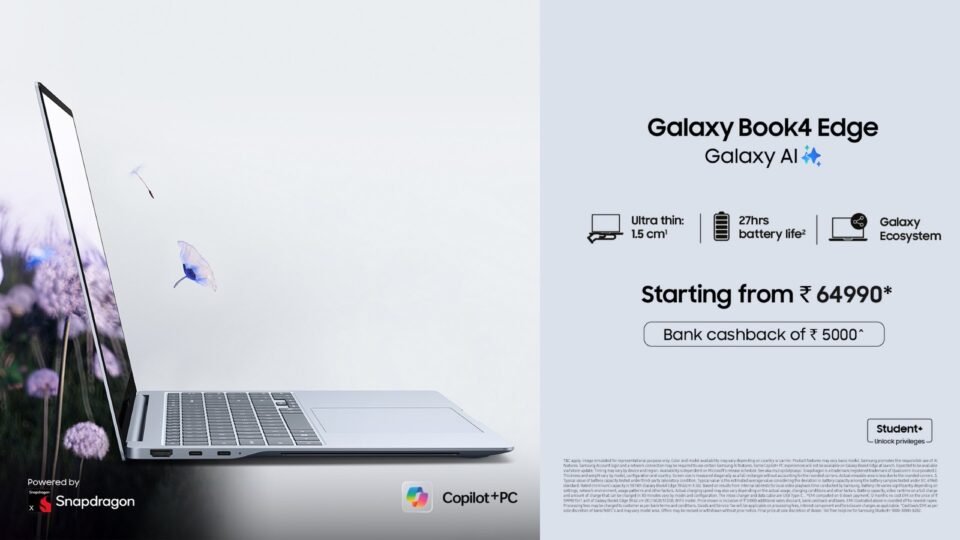
Starting today, the Galaxy Book4 Edge will be available at an introductory price of INR 59990*, with INR 5,000 cashback offer on major banks. Galaxy Book4 Edge will be available on www.samsung.com, Flipkart.com, Samsung Shop App, Samsung Experience Stores and select retail outlets across the country. Galaxy Book4 Edge comes in 15-inch size with an enhanced refined finish for a sleek, premium feel, created from a wide variety of recycled materials, including plastics, glass and aluminum. It also features a 1080p HD camera and Wi-Fi 7 connectivity.

Ultra-Portable Form Factor
Retaining its lightweight ultra-portable form factor, and long-lasting battery, Galaxy Book4 Edge combines top-tier hardware with AI-powered software features to deliver an immersive computing experience for work, play, and everything in between. The device is available in a new Arctic Blue colour with features such as Antiglare display, and a battery that lasts up to 27 hours.

Create Without Limits
Engineered for the AI era, Galaxy Book4 Edge is powered by the cutting-edge Qualcomm Snapdragon®️ X processor, delivering 45 TOPS of NPU performance for lightning-fast, on-device AI capabilities. It comes pre-loaded with Qualcomm’s Adreno graphics. Paired with Cocreator, users can turn sketches and text prompts into AI-generated artwork in seconds. Windows Studio Effects, powered by on-device AI, lets users enhance video calls with filters, voice focus, eye contact correction, and background blur—bringing studio-quality collaboration to everyday meetings.

Enterprise-Grade Security with Personalised Privacy
Security is core to the Galaxy Book4 Edge experience. Backed by Samsung Knox, the device offers multi-layer, defense-grade protection against threats—from hardware-level security to real-time monitoring.
As a Microsoft Secured-core PC, it also ensures firmware protection and elevated data integrity for business users. AI features like Recall operate locally on-device, giving users full control over what’s stored.
Privacy controls allow users to delete, filter, or manage their data easily, while Microsoft’s cloud-based security ensures added protection when needed.

Launch Price (INR) Bank Cashback (INR) *Net Effective Price
(INR)

64990 5000 59990

Share

Related posts

Why CML Isn’t a Solved Disease—And What Patients in India Need to Know* Over the past two decades, Chronic Myeloid Leukemia (CML) has undergone a transformation—from being a life-threatening condition to one that can be controlled with oral medication. Although survival rates have improved significantly, the idea of CML as a ‘manageable’ disease is now being questioned. Clinicians and patients alike are recognizing that the existing standard of care does not address the full picture—especially for India’s younger patient population, whose needs go far beyond survival. Dr Subhaprakash Sanyal Director of Haematology and BMT Services, Fortis Hospital, Mumbai, said, “There’s a common belief that starting treatment for CML means the journey is simple, but that isn’t the case. Many patients struggle to reach their treatment milestones as expected, and a significant portion need to change or stop their medication due to side effects or intolerance. In fact, about 30 to 40% discontinue their initial therapy within five years, highlighting that the standard approach doesn’t work for everyone.” CML disproportionately affects younger adults in India, where the median age of diagnosis is between 35 and 40 years—much younger than the average age of 50–60 in Western countries. At this life stage, patients are often building careers, supporting families, and planning long-term futures. In this context, treatment is no longer just about survival—it’s about maintaining energy, emotional well-being, professional productivity, and daily independence. Historically, the primary treatment goal in CML was achieving Major Molecular Response (MMR). But over the years, these goals have evolved. Today, physicians aim for deeper responses, particularly Deep Molecular Response (DMR). Achieving DMR paves the way for Treatment-Free Remission (TFR), where patients can potentially stop therapy altogether and remain in remission under medical supervision. These advanced milestones are particularly relevant to newly diagnosed patients, as reaching DMR within the first two years greatly improves the likelihood of achieving TFR down the line. Why So Many Patients Fall Short Despite clear treatment goals, a significant proportion fail to achieve MMR within the first year, and even fewer reach DMR by year two. One of the primary reasons is the impact of persistent, low-grade side effects—such as fatigue, joint pain, and gastrointestinal issues—which patients often tolerate silently but which meaningfully reduce their quality of life. These side effects also drive nonadherence, dose modifications, and ultimately treatment discontinuation. In fact, treatment intolerance is the leading cause of therapy discontinuation in the first two years of CML management. Adding to the complexity, current treatments—particularly ATP-competitive tyrosine kinase inhibitors (TKIs)—can affect not just the intended target but also unrelated biological pathways, causing off-target toxicity. This often leads to therapy switches, a strategy that increases both clinical and emotional burden without necessarily resolving the issue. A recent Indian analysis noted that nearly all CML patients report some form of low-grade side effect, many of which disrupt work and personal life but don’t qualify for hospitalization. As a result, patients feel caught in a difficult balance—managing a chronic illness while enduring ongoing discomfort or disruptions. The Case for Better-Tolerated, More Effective Therapies As the treatment landscape evolves, the need for therapies that not only offer deeper molecular responses but also better tolerability is becoming increasingly clear. Emerging therapies with novel mechanisms of action have begun to change the paradigm by offering comparable—or even superior—efficacy alongside fewer adverse events and lower discontinuation rates. In one international phase III trial, a newer therapy demonstrated a 74.1% MMR rate at 96 weeks, significantly higher than the 52.0% achieved by older therapies. It also showed a 54% lower risk of treatment discontinuation due to side effects, while nearly half of patients achieved MR4 and 30.9% achieved MR4.5, the deepest levels of response. These findings suggest that treatment no longer needs to be a trade-off between efficacy and day-to-day functioning. This shift is particularly important in the Indian context, where younger patients face the possibility of decades-long treatment. For them, the ability to tolerate therapy comfortably while still achieving long-term disease control is not a luxury—it’s a necessity. The Importance of Proactive Conversations Many patients continue older treatments unaware that newer, more tolerable options exist. This makes open doctor–patient conversations crucial—especially early in treatment. Patients should understand their goals, like DMR or TFR, and how their therapy aligns with them. Discussing side effects, lifestyle impact, and alternatives helps ensure care is not just effective, but sustainable and suited to their lives. While CML outcomes have improved, challenges remain—particularly for India’s younger patients. As treatment goals expand and better options emerge, the focus must shift from merely managing the disease to helping patients live well. The future of CML care lies in deeper responses, better tolerability, and enabling life beyond medication.

asianprimenews

I understand the burden of post-pregnancy and I want to help as many mothers as I can,” says actor Shweta Kawaatra on creating her community for new mothers on coto

asianprimenews

Samsung launches Enterprise Edition Flagship Galaxy S24 Ultra and Galaxy S24 Smartphones for Corporate Users in India

asianprimenews