
asianprimenews
Breaking News
Breaking NewsGeneralPublic Interest

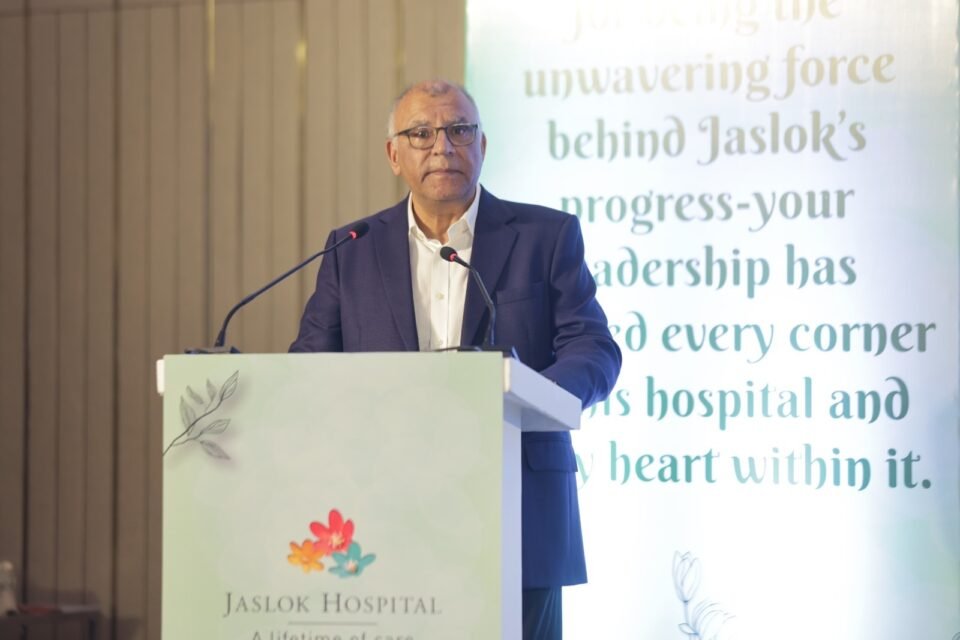
Leadership Transition at Jaslok Hospital: Vinod P. Chanrai Appointed as Chairman

Mumbai, 10 July 2025: Jaslok Hospital and Research Centre, one of Mumbai’s leading multi-specialty quaternary care hospitals, is pleased to announce a significant leadership transition. Mrs. Kanta Masand, who has served with distinction as Chairperson, will now assume the honorary role of Chairperson Emeritus. Mr. Vinod P. Chanrai, a longstanding Trustee and key figure in the Jaslok community, has taken over as Chairman.

Under Mrs. Masand’s stewardship, Jaslok Hospital has achieved exceptional growth in clinical services, infrastructure, and community outreach. Her tenure has been defined by a strong patient-first ethos and a deep commitment to upholding the hospital’s founding mission. Notable milestones include the establishment of Jaslok Annex during the COVID-19 pandemic and administering the highest number of COVID-19 vaccinations among private hospitals in Mumbai under its CSR program. Her support for social responsibility is further exemplified by her commitment to the Bal Asha orphanage.

Building on this strong foundation, Mr. Vinod P. Chanrai assumes the chairmanship with a clear vision for the hospital’s future. With a background in technology, innovation, and governance, Mr. Chanrai has played a pivotal role as Trustee in driving the hospital’s IT transformation, strengthening corporate governance, and enhancing research and medical education. His leadership signals a renewed focus on digital transformation, academic excellence, and next-generation healthcare delivery. This transition reinforces Jaslok Hospital’s commitment to strong governance, ethical and inclusive healthcare, and clinical leadership powered by research and technology.

Reflecting on her journey, *Mrs. Kanta Masand, Chairperson Emeritus,* said:”Jaslok has never been just a hospital – it is a living institution of care, compassion, and commitment, where tradition meets progress. It has been my life’s honour to serve a place where every decision is anchored in patient welfare and purpose. As I step into this new chapter, I remain devoted to upholding our founding values and guiding the hospital’s strategic future. I have deep faith that with Vinod’s visionary outlook, Jaslok is poised to embrace the future with heart and strength.”

Commenting on his new role, *Mr. Vinod P. Chanrai, Chairman,* said: “Assuming the role of Chairman at Jaslok Hospital is both an honour and a responsibility. Guided by the enduring values championed by Mrs. Masand, I look forward to steering Jaslok into a future defined by resilience, compassion, and cutting-edge healthcare. This includes embracing innovation, expanding our academic mission, and exploring the integration of AI to deliver meaningful improvements in patient care.”

Mr. Jitendra Haryan, CEO of Jaslok Hospital, added: “Leadership transitions are pivotal to the evolution of any institution. Mrs. Masand’s contributions have been invaluable, and I’ve personally witnessed the wisdom and integrity she brought to every decision. We welcome Mr. Chanrai as Chairman with great optimism. His passion and foresight will add a transformative dimension to Jaslok 2.0, marked by modernized infrastructure, innovation, and patient-centricity.”

Share

Related posts

WINNING AN OLYMPIC MEDAL TRANSFORMS NOT ONLY THE LIFE OF THE ATHLETE BUT ALSO THE LIVES OF THEIR FAMILY, SOCIETY, AND VILLAGE: SAKSHI MALIK The Olympic spirit took centre-stage at an event ‘An Olympic Dream: Sport in India,’ a panel discussion, hosted by the JSW Group, Asia Society India Centre, and the Consulate General of France in Mumbai at the Museum of Solutions. The event witnessed the attendance of Mr. Parth Jindal, Founder, JSW Sports along with Indian athletes Sakshi Malik, Dipa Karmakar and Priya Mohan. Mr. Parth Jindal, Founder, JSW Sports, spoke at an event ‘An Olympic Dream: Sport in India,’ a panel discussion hosted by the JSW Group, Asia Society India Centre, and the Consulate General of France in Mumbai, “I believe the way forward for Indian sports is a robust public-private partnership. The reach and funding the government provides are unparalleled, but the private sector adds essential elements like sports science, nutrition, and technology, enhancing the government’s efforts. Over the past decade, this collaboration has flourished. Initiatives like the Target Olympic Podium Scheme (TOPS), the Mission Olympic Cell, and Khelo India are excellent examples of this synergy, developed in consultation with the private sector. “Despite this progress, the private sector primarily operates within existing government infrastructure, except for a few notable ventures like the Inspire Institute of Sport. To truly elevate Indian sports, we need at least 10 such centres across the country—ideally one in every state. The government is already encouraging private entities to manage these centres, but more involvement is needed. “There are two main challenges in Indian sports: insufficient private sector participation and persistent issues within sports federations, which still suffer from political interference. However, improvements are visible each year. With the Paris Olympics approaching, the collaboration between the government and the private sector is more concentrated and symbiotic than ever, and I am optimistic about the results.” “One crucial aspect of our sports journey has been the emergence of heroes who inspire the next generation. From the three heroes of 2008, we saw six more in 2012, followed by two in 2016. In Tokyo, our hockey team and six other medallists stood out, along with the exceptional Neeraj Chopra in track and field. Each hero, like Vijender Singh in boxing or Sakshi Malik in wrestling, ignites dreams and possibilities in their respective sports. Neeraj Chopra’s achievements in javelin, a sport previously deemed beyond our genetic capabilities, have paved the way for future champions. Now, we have three Indian men’s javelin throwers heading to Paris, a testament to our evolving athletic prowess.” Mr. Parth Jindal, Founder, JSW Sports, further elaborated about Neeraj Chopra, “Neeraj Chopra’s story is a remarkable testament to talent identification and resilience. We discovered Neeraj in 2015 through our sports excellence program, and in 2016, he shattered the World Junior Championship record and won a gold medal in Poland with an 86.48-meter throw. Had he achieved that throw at the Rio Olympics, he would have secured a bronze medal. His journey only became more compelling from there. “The Sports Authority of India (SAI) brought in Uwe Hohn, the only man to throw over 100 meters, as Neeraj’s coach, leading to a significant change in his technique. Unfortunately, this change resulted in a dislocated elbow in 2019, after Neeraj had won gold at the 2018 Asian Games. Many feared this injury would end his career, especially with the Tokyo Olympics looming in 2020. However, the postponement of the Olympics due to COVID-19 gave Neeraj a crucial year to recover. “During the pandemic, with Indian athletes struggling to obtain visas for overseas training, we reached out to the External Affairs Minister, Mr. S. Jaishankar, advocating for urgent visa approvals for Neeraj and wrestler Bajrang Punia. The government swiftly responded, granting them visas—Neeraj received a Schengen visa for France, and Bajrang went to Russia. This enabled them to participate in key tournaments leading up to Tokyo. “When asked why we prioritized these two athletes, my response was rooted in our experience: after nine years in sports development, we believed they were India’s best bets to win medals. As it turned out, both Neeraj and Bajrang proved us right by winning medals at the Tokyo Olympics.” Sakshi Malik, an Olympics bronze medallist, spoke at an event ‘An Olympic Dream: Sport in India,’ a panel discussion hosted by the JSW Group, Asia Society India Centre, and the Consulate General of France in Mumbai, “An Olympic dream is not just an athlete’s dream; it’s the dream of an entire family. Winning an Olympic medal transforms not only the life of the athlete but also the lives of their family, society, and village. After my medal, significant changes occurred. The Chhotu Ram Stadium in Rohtak, where I trained, went from having a tin roof to becoming an AC hall. A stadium was even built in my village and named after me. An Olympic medal creates numerous opportunities, especially for children, allowing them to train in better facilities. “The craze for wrestling in Haryana has surged. Everywhere you go, there’s a stadium every ten minutes, and you’ll find girls training in each one. The old mindset that girls couldn’t wrestle has changed dramatically. The misconceptions that girls are impure and shouldn’t participate in wrestling have been debunked. Now, girls are proving that they too can excel in wrestling. “There was a time when people believed that girls couldn’t wrestle, but today, this has changed. For the first time, five girls are going to the Olympics for wrestling while only one boy is going. Girls, who were once suppressed, are now boldly stepping forward and excelling in wrestling. “After my medal win, no one enters wrestling merely thinking about securing a job or a benefit. They now start with the goal of winning an Olympic medal. This shift in mindset is incredibly inspiring.”

asianprimenews

Deepika Padukone Turns 38: Here are the 8 highest-rated titles of the actress on IMDb

asianprimenews

R K SWAMY LIMITED INITIAL PUBLIC OFFER TO OPEN ON MARCH 4, 2024

asianprimenews