
asianprimenews
Breaking NewsGeneralPublic Interest

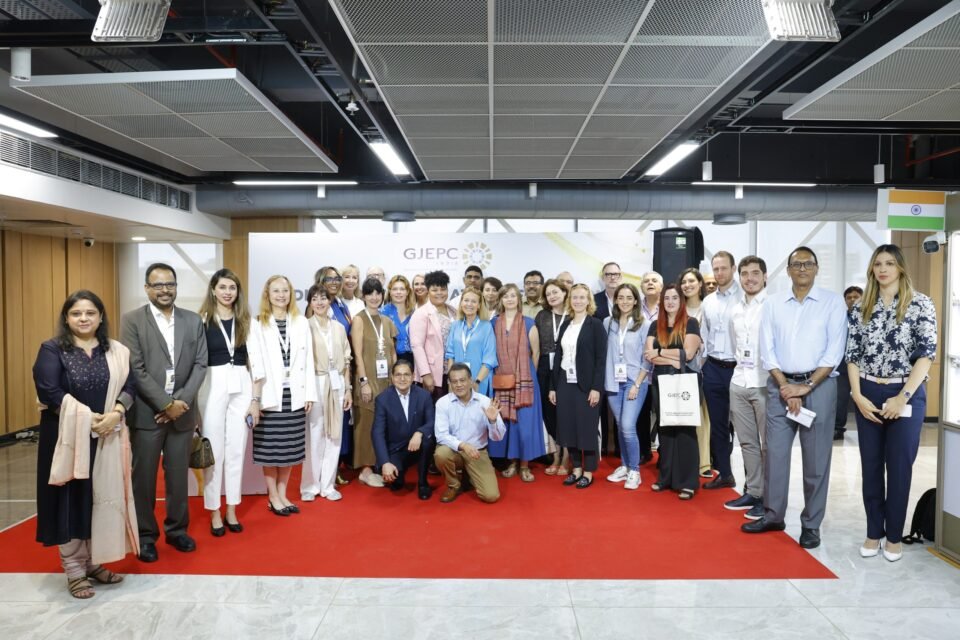
GJEPC’s 3rd edition of Gem & Jewellery Buyer Seller Meet held at the iconic Bharat Ratnam Mega CFC SEEPZ Indian exhibitors catered to global buyers from the U.S., Brazil, Spain, Germany, Mexico, Saudi Arabia, the Dominican Republic, and Canada

National, 30th September 2024: The Gem and Jewellery Export Promotion Council of India (GJEPC), the apex trade organization dedicated to promoting Indian gem and jewellery exports worldwide, organised the 3rd edition of the Gem and Jewellery Buyer Seller Meet (G&J BSM) at the iconic Bharat Ratnam, Mega CFC SEEPZ in Mumbai.


The two-day event was graced by the presence of distinguished guests including Shri Dnyaneshwar Patil, Development Commissioner, SEEPZ, Shri C.P.S Chauhan, IRS, Joint Development Commissioner, SEEPZ, Shri Kirt Bhansali, Vice Chairman, GJEPC, Shri Colin Shah, Head – Working Group, Bharat Ratnam, Mega CFC, Ms Mia Katrin, International Coordinator, USA, Ms. Ali Pastorini, International Coordinator, Latin America and Ms. Olga Gonzalez, Pietra PR LLC.


Over 28 international buyers are visiting the G&J BSM from the USA, Brazil, Spain, Germany, Mexico, Saudi Arabia, the Dominican Republic, and Canada


The exhibitors are: V.M. Jewellery, Goldstar Jewellery Pvt Ltd., Kama Jewelry Private Limited, Gemcrown Jewellery Private Limited, Ethos Jewelry Designs Llp, Elegant Collection, United Jewellery Mfg. Pvt. Ltd., Shish Jewels Private Limited, Uni Design Jewellery Pvt. Ltd, K.G.K. Creations (India) Pvt. Ltd. and Minal Infojewels Limited.


Shri Kirit Bhansali, Vice Chairman, GJEPC, stated, “India has long been a cornerstone in the global jewellery trade, known for its extraordinary craftsmanship and deep-rooted traditions in jewellery-making. We take pride in offering a diverse portfolio of products that not only meet but exceed the expectations of international buyers. Our commitment to ethical practices and transparency has earned India its reputation as a trusted and reliable partner in the global marketplace.”


He further emphasized, “In the face of evolving global dynamics, it is essential for the industry to come together and adapt. GJEPC would be making concerted efforts towards promotion of diamond jewellery and building on the demand for the product across key consuming markets. GJEPC’s has collaborated with the Natural Diamond Council and the World Gold Council for generic promotion of diamond and gold jewellery respectively. We encourage all stakeholders to unite with us in leveraging these efforts to amplify our presence and create lasting value for the industry as a whole.”


Welcoming the international buyers to the Buyer-Seller meet, Colin Shah, Head – Working Group, Bharat Ratnam, Mega CFC said, “Bharat Ratnam is a pioneering initiative in India and Asia, possibly even globally, where we’ve established a Common Facility Centre offering 20 advanced technical services. These include lab testing, 3D printing, and more, designed to help our members compete on a global scale. The services are available for both domestic and international markets.”


GJEPC’s USA coordinator Ms. Mia Katerine said, “GJEPC’s Buyer Seller Meet is a great opportunity and a win-win situation for both the markets. There is a great opportunity for Indian jewellery exporters to tap the vast opportunities in the U.S., which has over 20,000 jewellery retailers and wholesalers. India is ideal for wholesale manufacturing and unique craftsmanship and exquisite designs. More importantly, India is quite competitive and cost-efficient despite having the latest technology in manufacturing, cutting and polishing diamonds.”


Brazilian retailers Mr. Nelson and Rodolfo Semeoni from Monte Cristo said, “Since we are one of the biggest jewellery retailers in Brazil, we are looking for strategic partners in India. Indian gem & jewellery industry is quite strong in all diverse aspects of the value chain. Brazil market also values precious stones such as emeralds and Jaipur in India is the global hub for precious stones. The bridal market in Brazil has evolved and we offer brides two distinct opportunities in terms of diamond rings and white gold jewellery – all of which can be sourced directly from India. We are also looking for premiumisation for discerning high end customers and India can help us there too.”


The BSM followed a structured Buyer Seller Meet format, featuring pre-scheduled one-on-one meetings lasting approximately 30 to 40 minutes between buyers and sellers during the two day meet.


The United States holds immense significance for the Indian gem and jewellery industry. Notably, cut and polished diamonds account for a substantial portion of these exports. India’s pivotal role in the global gem and jewellery supply chain have created deep-rooted ties between the two nations. GJEPC has further lined up events aimed at providing Indian gem and jewellery manufacturers with global exposure in the near future.


About The Gem and Jewellery Export Promotion Council (GJEPC)

The Gem & Jewellery Export Promotion Council (GJEPC), set up by the Ministry of Commerce, Government of India (GoI) in 1966, is one of several Export Promotion Councils (EPCs) launched by the Indian Government, to boost the country’s export thrust, when India’s post-Independence economy began making forays in the international markets. Since 1998, the GJEPC has been granted autonomous status. The GJEPC is the apex body of the gems & jewellery industry and today represents 10000+ members in the sector.  With headquarters in Mumbai, GJEPC has Regional Offices in New Delhi, Kolkata, Chennai, Surat and Jaipur, all of which are major centres for the industry. It thus has a wide reach and is able to have a closer interaction with members to serve them in a direct and more meaningful manner. Over the past decades, GJEPC has emerged as one of the most active EPCs and has continuously strived to both expand its reach and depth in its promotional activities as well as widen and increase services to its members.

Facebook: www.facebook.com/GJEPC

Instagram: www.instagram.com/gjepcindia

Youtube: www.youtube.com/gjepcindia

Twitter: www.twitter.com/GJEPCIndia

Share

Related posts

Honourable Prime Minister of India Shri Narendra Modi and the Prime Minister of the United Kingdom Rt Hon. Sir Keir Starmer To Grace Global Fintech Fest 2025 With Their August Presence

asianprimenews

World Sustainable Development Summit (WSDS) 2025 Inaugurated in New Delhi Strengthening Partnerships for Climate Action and Sustainable Development

asianprimenews

Why CML Isn’t a Solved Disease—And What Patients in India Need to Know* Over the past two decades, Chronic Myeloid Leukemia (CML) has undergone a transformation—from being a life-threatening condition to one that can be controlled with oral medication. Although survival rates have improved significantly, the idea of CML as a ‘manageable’ disease is now being questioned. Clinicians and patients alike are recognizing that the existing standard of care does not address the full picture—especially for India’s younger patient population, whose needs go far beyond survival. Dr Subhaprakash Sanyal Director of Haematology and BMT Services, Fortis Hospital, Mumbai, said, “There’s a common belief that starting treatment for CML means the journey is simple, but that isn’t the case. Many patients struggle to reach their treatment milestones as expected, and a significant portion need to change or stop their medication due to side effects or intolerance. In fact, about 30 to 40% discontinue their initial therapy within five years, highlighting that the standard approach doesn’t work for everyone.” CML disproportionately affects younger adults in India, where the median age of diagnosis is between 35 and 40 years—much younger than the average age of 50–60 in Western countries. At this life stage, patients are often building careers, supporting families, and planning long-term futures. In this context, treatment is no longer just about survival—it’s about maintaining energy, emotional well-being, professional productivity, and daily independence. Historically, the primary treatment goal in CML was achieving Major Molecular Response (MMR). But over the years, these goals have evolved. Today, physicians aim for deeper responses, particularly Deep Molecular Response (DMR). Achieving DMR paves the way for Treatment-Free Remission (TFR), where patients can potentially stop therapy altogether and remain in remission under medical supervision. These advanced milestones are particularly relevant to newly diagnosed patients, as reaching DMR within the first two years greatly improves the likelihood of achieving TFR down the line. Why So Many Patients Fall Short Despite clear treatment goals, a significant proportion fail to achieve MMR within the first year, and even fewer reach DMR by year two. One of the primary reasons is the impact of persistent, low-grade side effects—such as fatigue, joint pain, and gastrointestinal issues—which patients often tolerate silently but which meaningfully reduce their quality of life. These side effects also drive nonadherence, dose modifications, and ultimately treatment discontinuation. In fact, treatment intolerance is the leading cause of therapy discontinuation in the first two years of CML management. Adding to the complexity, current treatments—particularly ATP-competitive tyrosine kinase inhibitors (TKIs)—can affect not just the intended target but also unrelated biological pathways, causing off-target toxicity. This often leads to therapy switches, a strategy that increases both clinical and emotional burden without necessarily resolving the issue. A recent Indian analysis noted that nearly all CML patients report some form of low-grade side effect, many of which disrupt work and personal life but don’t qualify for hospitalization. As a result, patients feel caught in a difficult balance—managing a chronic illness while enduring ongoing discomfort or disruptions. The Case for Better-Tolerated, More Effective Therapies As the treatment landscape evolves, the need for therapies that not only offer deeper molecular responses but also better tolerability is becoming increasingly clear. Emerging therapies with novel mechanisms of action have begun to change the paradigm by offering comparable—or even superior—efficacy alongside fewer adverse events and lower discontinuation rates. In one international phase III trial, a newer therapy demonstrated a 74.1% MMR rate at 96 weeks, significantly higher than the 52.0% achieved by older therapies. It also showed a 54% lower risk of treatment discontinuation due to side effects, while nearly half of patients achieved MR4 and 30.9% achieved MR4.5, the deepest levels of response. These findings suggest that treatment no longer needs to be a trade-off between efficacy and day-to-day functioning. This shift is particularly important in the Indian context, where younger patients face the possibility of decades-long treatment. For them, the ability to tolerate therapy comfortably while still achieving long-term disease control is not a luxury—it’s a necessity. The Importance of Proactive Conversations Many patients continue older treatments unaware that newer, more tolerable options exist. This makes open doctor–patient conversations crucial—especially early in treatment. Patients should understand their goals, like DMR or TFR, and how their therapy aligns with them. Discussing side effects, lifestyle impact, and alternatives helps ensure care is not just effective, but sustainable and suited to their lives. While CML outcomes have improved, challenges remain—particularly for India’s younger patients. As treatment goals expand and better options emerge, the focus must shift from merely managing the disease to helping patients live well. The future of CML care lies in deeper responses, better tolerability, and enabling life beyond medication.

asianprimenews