
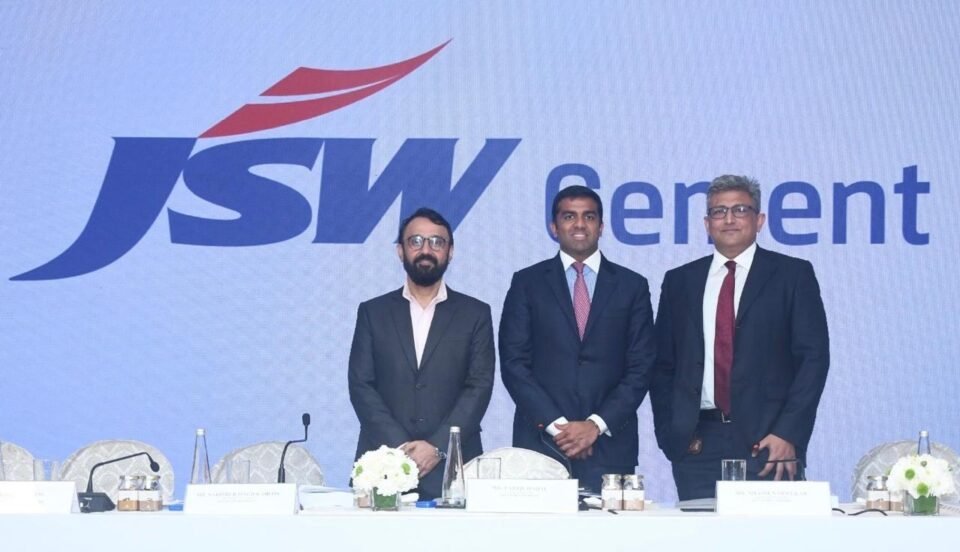
Mumbai, August 4, 2025: JSW Cement Limited (the “Company”) has fixed the price band of ₹ 139/- to ₹ 147/- per Equity Share of face value ₹10 each for its initial public offer.
The initial public offer (“IPO” or “Offer”) of the Company will open on Thursday, August 7, 2025, for subscription and close on Monday, August 11, 2025. Investors can bid for a minimum of 102Equity Shares and in multiples of 102 Equity Shares thereafter.
The IPO is a mix of fresh issue of shares up to Rs 1,600 crores and an offer for sale for sale up to Rs 2,000 crores by the selling shareholders.
The proceeds from the fresh issue to the extent of up to Rs 800 crores will be utilized for part financing the cost of establishing a new integrated cement unit at Nagaur, Rajasthan; up to Rs 520 crores for prepayment or repayment, in full or in part, of all or a portion of certain outstanding borrowings availed by the Company; and general corporate purposes.
JSW Cement Limited is a part of the JSW Group, a multinational conglomerate with a portfolio of diversified businesses across various sectors such as steel, energy, maritime, infrastructure, defence, business-to-business e-commerce, realty, paints, sports and venture capital. It started its operations in 2009 in the southern region of India through our single grinding unit in Vijayanagar, Karnataka.
The Company is among the top three fastest growing cement manufacturing companies in India in terms of increase in installed grinding capacity and sales volume from Fiscal 2015 to Fiscal 2025 (among the peers in terms of installed capacity and sales volume), according to the CRISIL Report. It is also among the top 10 cement companies in India in terms of installed capacity and sales volume as of March 31, 2025, according to CRISIL Report.
The Company is India’s largest manufacturer of ground granulated blast furnace slag (“GGBS”), an eco-friendly product produced entirely from blast furnace slag (a by-product of the steel manufacturing process), with a market share in terms of GGBS sales of 84.00% in Fiscal 2025, according to the CRISIL Report.
The Company’s product portfolio consists of blended cement (including PSC, PCC and PPC), GGBS, ordinary portland cement (“OPC”), clinker and a range of allied cementitious products such as ready mix concrete (“RMC”), screened slag, construction chemicals and waterproofing compounds. As of March 31, 2025, the Company operates seven plants in India, which comprise one integrated unit, one clinker unit and five grinding units across the states of Andhra Pradesh (Nandyal plant), Karnataka (Vijayanagar plant), Tamil Nadu (Salem plant), Maharashtra (Dolvi plant), West Bengal (Salboni plant), Odisha (Jajpur plant and our majority owned Shiva Cement Limited clinker unit).
JSW Cement Limited has the lowest carbon dioxide emission intensity among its peer cement manufacturing companies in India and globally, according to the CRISIL Report.
The Company sells its products through a well-connected distribution network. As of March 31, 2025, it had a network of 4,653 dealers, 8,844 sub-dealers and 158 warehouses.
JM Financial Limited, Axis Capital Limited, Citigroup Global Markets India Private Limited, DAM Capital Advisors Limited, Goldman Sachs (India) Securities Private Limited, Jefferies India Private Limited, Kotak Mahindra Capital Company Limited, and SBI Capital Markets Limited are the book-running lead managers to the Offer, and KFin Technologies Limited is the registrar of the Offer.
The Offer is being made through the book-building process, wherein not more than 50% of the Offer shall be available for allocation on a proportionate basis to qualified institutional buyers, not less than 15% of the Offer shall be available for allocation to non-institutional investors, and not less than 35% of the Offer shall be available for allocation to retail individual investors.
DISCLAIMERS:
DISCLAIMER CLAUSE OF SEBI: SEBI only gives its observations on the offer documents and this does not constitute approval of either the Offer or the specified securities stated in the Offer Documents. The investors are advised to refer to page 614 of the RHP for the full text of the disclaimer clause of SEBI.
DISCLAIMER CLAUSE OF NSE (The Designated Stock Exchange): It is to be distinctly understood that the permission given by BSE Limited should not in any way be deemed or construed that the RHP has been cleared or approved by BSE Limited nor does it certify the correctness or completeness of any of the contents of the RHP. The investors are advised to refer to the page 620 of the RHP for the full text of the disclaimer clause of BSE.
DISCLAIMER CLAUSE FOR INVESTORS: This announcement does not constitute an invitation or offer of securities for sale in any jurisdiction. The Equity Shares offered in the Offer have not been and will not be registered under the U.S. Securities Act of 1933, as amended (the “U.S. Securities Act”) or any state securities laws in the United States and unless so registered, may not be offered or sold within the United States except pursuant to an exemption from, or in a transaction not subject to, the registration requirements of the U.S. Securities Act and in accordance with any applicable U.S. state securities laws. Accordingly, the Equity Shares are being offered and sold within the United States only to “qualified institutional buyers”, as defined in Rule 144A (“Rule 144A”) under the U.S. Securities Act, in transactions exempt from the registration requirements of the U.S. Securities Act, and outside the United States in “offshore transactions” as defined in, and in reliance on ,Regulation S (“Regulation S”) under the U.S. Securities Act, and in accordance with the applicable laws of the jurisdictions where such offers and sales are being made. There will beno public offering of the Equity Shares in the United States.
About JSW Group: The US$23 billion JSW Group is one of the fastest growing conglomerates in India with its businesses spanning across multiple sectors, including steel, energy, infrastructure, cement, paints, defence, automobiles, e-commerce, sports, realty and venture capital. Over the past three decades, JSW Steel – the flagship company of the Group – has grown from a single manufacturing unit to become India’s leading integrated steel company with consolidated crude steel capacity of 35.7 MTPA, including 1.5 MTPA in the US. Domestic crude steel capacity stands at 34.2 MTPA including 5 MTPA under commissioning. Its next phase of growth will take consolidated capacity to 43.5 MTPA over next three years. The Company’s plant at Vijayanagar in the southern state of Karnataka is the largest single-location steel-producing facility in India with current capacity of 17.5 MTPA (including 5 MTPA under commissioning). JSW Steel has a strategic collaboration with JFE Steel of Japan, enabling JSW to access new and state-of-the-art technologies to produce and offer high-value special steel products to its customers. JSW Steel aims to reduce its CO2 emissions by 42% from its steel-making operations by 2030 and has committed to achieve net neutral in carbon emission for all operations under its direct control by 2050. JSW Steel aims to lead the energy transition by powering steel-making operations entirely by renewable energy by 2030.