
asianprimenews
Breaking NewsGeneralPublic Interest

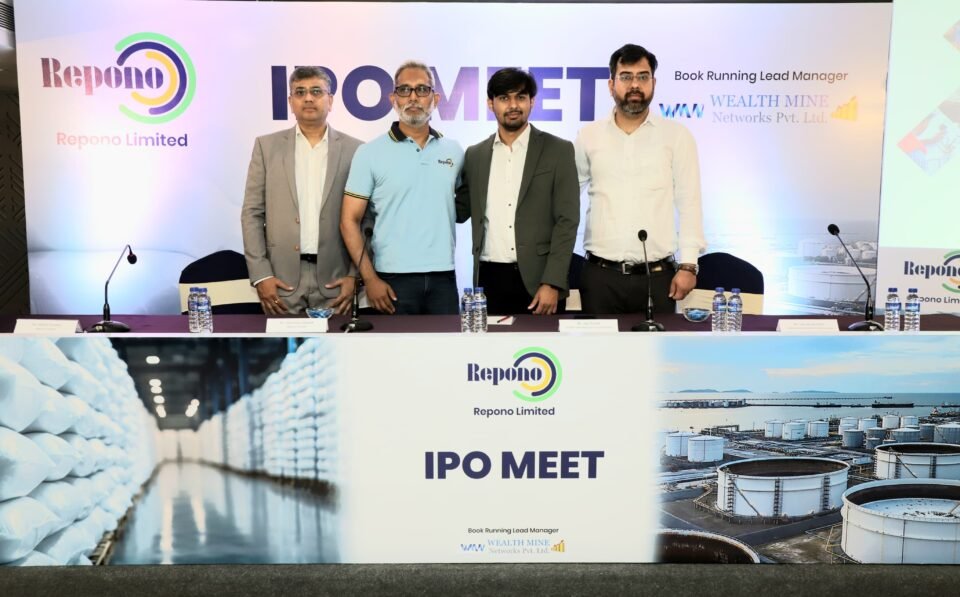
Repono Limited IPO Opens on July 28, 2025

Mumbai, July 22, 2025 –Repono Limited (The Company, Repono) is a specializes in

providing comprehensive 360-degree warehousing and liquid terminal solutions, proposes

to open its Initial Public Offering on Monday, July 28, 2025, aiming to raise ₹ 26.68 Crore (At

Upper Price Band), with shares to be listed on the BSE SME platform.

The issue size is 27,79,200 equity shares at a face value of ₹ 10 each with a price band of ₹

91 – ₹ 96 Per Share.

Equity Share Allocation

• QIB Anchor Portion – 7,92,000 Equity Shares

• Qualified Institutional Buyer – 5,28,000 Equity Shares

• Non-Institutional Investors – 3,96,000 Equity Shares

• Retail Individual Investors – 9,24,000 Equity Shares

• Market Maker – 1,39,200 Equity Shares

The net proceeds from the IPO will be utilized for capital expenditure towards the purchase

of forklifts, hand pallet trolleys, reach stackers, setting up of warehouse racking systems,

development of warehouse management software, working capital requirements, and

general corporate purposes. The anchor portion will open on Friday, July 25, 2025 and issue

will close on Monday, July 30, 2025.

The Book Running Lead Manager to the Issue is Wealth Mine Networks Private Limited, The

Registrar to the Issue is Cameo Corporate Services Limited.

Mr. Dibyendu Deepak, Managing Director of Repono Limited expressed, “The launch of

our IPO is a significant milestone in company’s journey. Over the years, we have built a

strong foundation in India’s oil and petrochemical logistics space by consistently

delivering reliable, safe, and efficient services. From managing high-volume liquid

terminals to offering integrated warehousing and O&M solutions, our focus has always

been on quality, compliance, and customer satisfaction.

This IPO represents more than just a capital raise — it is an opportunity to accelerate our

growth, enhance operational capabilities, and deepen our presence in key markets. It will

enable us to invest in advanced infrastructure, strengthen our technology backbone, and

pursue strategic opportunities with greater agility.

We are delighted about this next phase and remain committed to creating long-term value

for our investors, clients, and partners. With a clear vision, experienced team, and strong

industry relationships, we look forward to shaping a more connected and efficient logistics

future.”

CA Shashank Doshi, Chairman of Wealth Mine Networks Private Limited said, “We are

pleased to be associated with Repono Limited as they take a significant step forward with

the launch of their Initial Public Offering. Repono has established itself as a specializedservice provider in India’s oil and petrochemical logistics space, offering integrated

warehousing, terminal management, and O&M solutions.

India’s oil and petrochemical logistics sector is poised for strong, long-term growth, driven

by rising industrial demand, increasing infrastructure investments, and a shift toward

more organized, tech-enabled supply chains. The company is well-positioned to capitalize

on these trends. This IPO will support the company’s long-term vision, enabling it to scale

operations, enhance service capabilities, and further strengthen its position in this

evolving and opportunity-rich industry.”

About Repono Limited:

Repono Limited (The Company, Repono) is a specialized service provider offering 360-

degree warehousing and liquid terminal solutions to India’s oil and petrochemical sector.

Its services span consultancy, engineering, operations and maintenance (O&M), and

value-added services, catering to top public and private sector enterprises.

Repono is a trusted O&M partner in the oil value chain, managing assets from crude oil

and refined fuels to ethanol, petrochemical terminals, and specialty chemical warehouses.

It operates India’s most advanced FFS polymer packaging lines and oversees Asia’s largest

lube oil plant (IOCL, Chennai). Repono handles a wide range of materials—from melamine

and carbon black to polymers (PP, HDPE, PVC) and specialty chemicals like phenol and

acetone—ensuring safe, efficient operations across traditional and advanced packaging

systems.

In FY25, The Company achieved a Revenue of ₹ 5,111.54 Lakhs, EBITDA of ₹ 813.31 Lakhs &

PAT of ₹ 514.90 Lakhs.

Disclaimer:

Certain statements in this document that are not historical facts are forward looking

statements. Such forward-looking statements are subject to certain risks and

uncertainties like government actions, local, political or economic developments,

technological risks, and many other factors that could cause actual results to differ

materially from those contemplated by the relevant forward-looking statements. The

Company will not be in any way responsible for any action taken based on such statements

and undertakes no obligation to publicly update these forward-looking statements to

reflect subsequent events or circumstances.

Share

Related posts

The Nest, Malabar Hill: Mumbai’s New Urban Forest – Rebuilding a haven for nature enthusiasts

asianprimenews

Why CML Isn’t a Solved Disease—And What Patients in India Need to Know* Over the past two decades, Chronic Myeloid Leukemia (CML) has undergone a transformation—from being a life-threatening condition to one that can be controlled with oral medication. Although survival rates have improved significantly, the idea of CML as a ‘manageable’ disease is now being questioned. Clinicians and patients alike are recognizing that the existing standard of care does not address the full picture—especially for India’s younger patient population, whose needs go far beyond survival. Dr Subhaprakash Sanyal Director of Haematology and BMT Services, Fortis Hospital, Mumbai, said, “There’s a common belief that starting treatment for CML means the journey is simple, but that isn’t the case. Many patients struggle to reach their treatment milestones as expected, and a significant portion need to change or stop their medication due to side effects or intolerance. In fact, about 30 to 40% discontinue their initial therapy within five years, highlighting that the standard approach doesn’t work for everyone.” CML disproportionately affects younger adults in India, where the median age of diagnosis is between 35 and 40 years—much younger than the average age of 50–60 in Western countries. At this life stage, patients are often building careers, supporting families, and planning long-term futures. In this context, treatment is no longer just about survival—it’s about maintaining energy, emotional well-being, professional productivity, and daily independence. Historically, the primary treatment goal in CML was achieving Major Molecular Response (MMR). But over the years, these goals have evolved. Today, physicians aim for deeper responses, particularly Deep Molecular Response (DMR). Achieving DMR paves the way for Treatment-Free Remission (TFR), where patients can potentially stop therapy altogether and remain in remission under medical supervision. These advanced milestones are particularly relevant to newly diagnosed patients, as reaching DMR within the first two years greatly improves the likelihood of achieving TFR down the line. Why So Many Patients Fall Short Despite clear treatment goals, a significant proportion fail to achieve MMR within the first year, and even fewer reach DMR by year two. One of the primary reasons is the impact of persistent, low-grade side effects—such as fatigue, joint pain, and gastrointestinal issues—which patients often tolerate silently but which meaningfully reduce their quality of life. These side effects also drive nonadherence, dose modifications, and ultimately treatment discontinuation. In fact, treatment intolerance is the leading cause of therapy discontinuation in the first two years of CML management. Adding to the complexity, current treatments—particularly ATP-competitive tyrosine kinase inhibitors (TKIs)—can affect not just the intended target but also unrelated biological pathways, causing off-target toxicity. This often leads to therapy switches, a strategy that increases both clinical and emotional burden without necessarily resolving the issue. A recent Indian analysis noted that nearly all CML patients report some form of low-grade side effect, many of which disrupt work and personal life but don’t qualify for hospitalization. As a result, patients feel caught in a difficult balance—managing a chronic illness while enduring ongoing discomfort or disruptions. The Case for Better-Tolerated, More Effective Therapies As the treatment landscape evolves, the need for therapies that not only offer deeper molecular responses but also better tolerability is becoming increasingly clear. Emerging therapies with novel mechanisms of action have begun to change the paradigm by offering comparable—or even superior—efficacy alongside fewer adverse events and lower discontinuation rates. In one international phase III trial, a newer therapy demonstrated a 74.1% MMR rate at 96 weeks, significantly higher than the 52.0% achieved by older therapies. It also showed a 54% lower risk of treatment discontinuation due to side effects, while nearly half of patients achieved MR4 and 30.9% achieved MR4.5, the deepest levels of response. These findings suggest that treatment no longer needs to be a trade-off between efficacy and day-to-day functioning. This shift is particularly important in the Indian context, where younger patients face the possibility of decades-long treatment. For them, the ability to tolerate therapy comfortably while still achieving long-term disease control is not a luxury—it’s a necessity. The Importance of Proactive Conversations Many patients continue older treatments unaware that newer, more tolerable options exist. This makes open doctor–patient conversations crucial—especially early in treatment. Patients should understand their goals, like DMR or TFR, and how their therapy aligns with them. Discussing side effects, lifestyle impact, and alternatives helps ensure care is not just effective, but sustainable and suited to their lives. While CML outcomes have improved, challenges remain—particularly for India’s younger patients. As treatment goals expand and better options emerge, the focus must shift from merely managing the disease to helping patients live well. The future of CML care lies in deeper responses, better tolerability, and enabling life beyond medication.

asianprimenews

Unlocking Imagination: A sneak peek into an AI-fueled transformation. These Bollywood leading ladies as Brie Larson in ‘The Marvels’ is truly interesting. Who would you pick to join the superhero league?”

asianprimenews